
The Real-World Lab · 2026–2031
Five years of testing. Real procedures. Public learning curve.
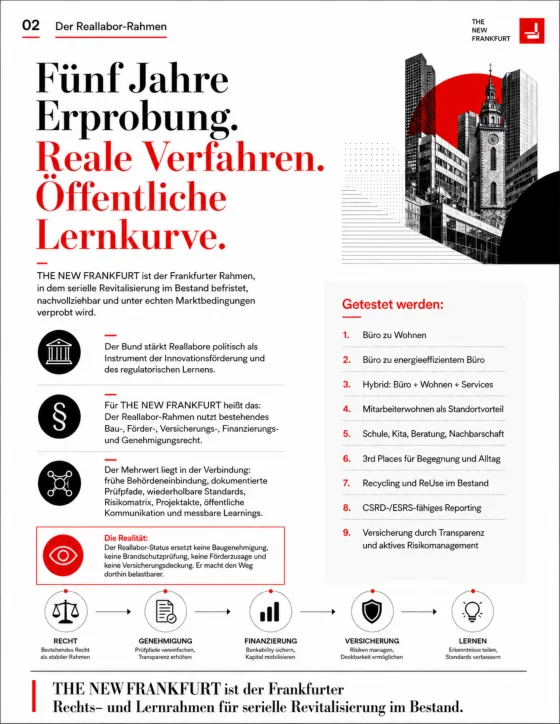
THE NEW FRANKFURT is the Frankfurt framework in which serial revitalization of existing buildings is tested: time-limited, transparent and under real market conditions.
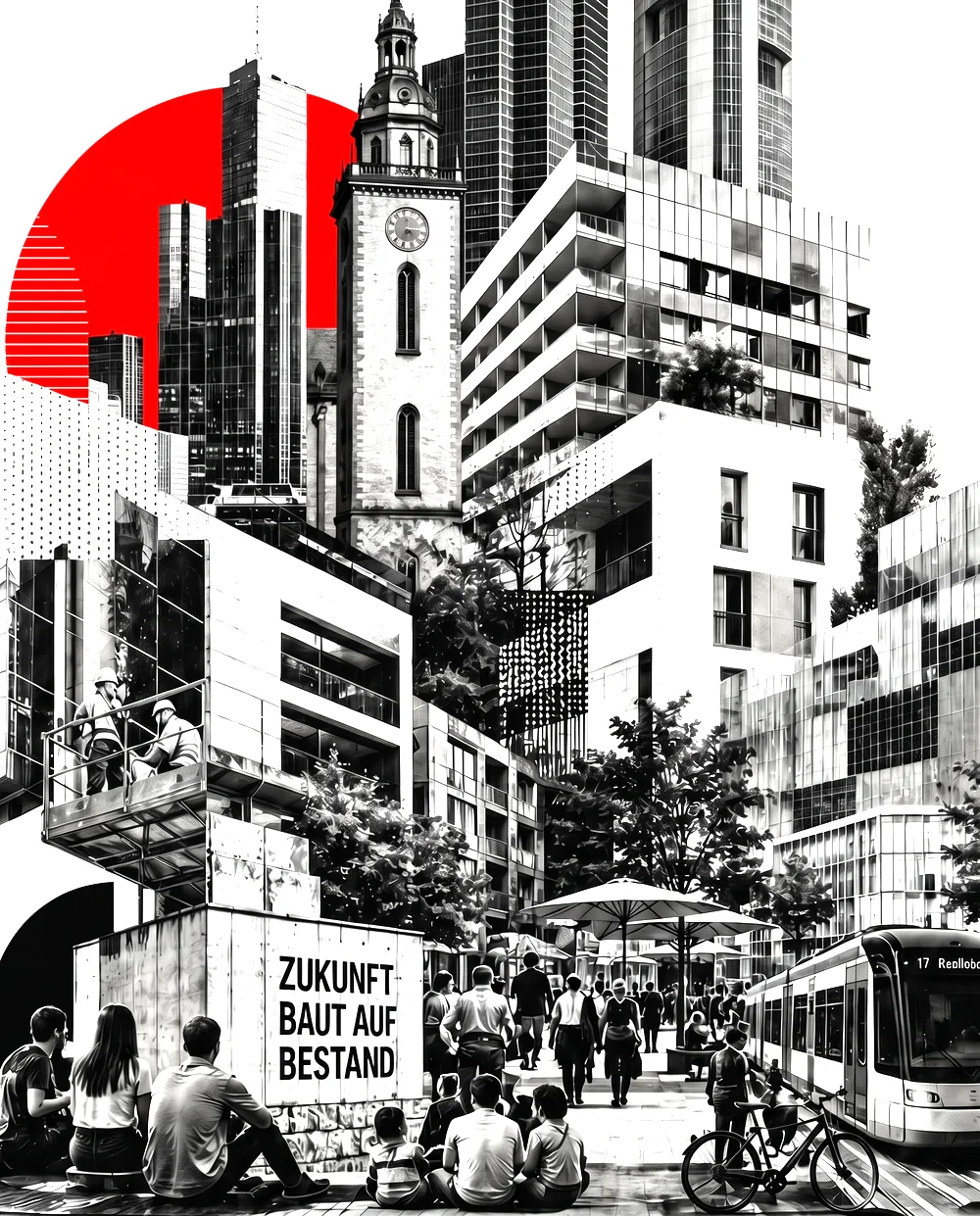
The Parallel
What was successfully implemented 100 years ago is becoming possible again today.
1925–1930
0
apartments in 6 years
Ernst May and Ludwig Landmann created an urban program that set new standards. DAS NEUE FRANKFURT was on a par with the BAUHAUS in Berlin and Dessau: serial construction, standardized floor plans, normed planning and components, and an administration that organized speed.
2026–2031
0
apartments in 6 years
THE NEW FRANKFURT translates this logic into the present: revitalization of existing buildings along Mainzer Landstraße, apartments from offices, vertical densification, made financeable with digital twins, standardized conversion packages and transparency for banks, investors and administration.
Existing law. A resilient path.
The framework does not invent a special world. It uses existing building, subsidy, insurance and permitting law and makes the path through it faster and more resilient: early involvement of authorities, documented review paths, repeatable standards.
The reality:
Real-world lab status does not replace a building permit, a fire safety review, a funding commitment or insurance coverage. It makes the path there more resilient.
What is being tested:
- 1.Office to housing
- 2.Hybrid: office, housing and services
- 3.Employee housing as a location advantage
- 4.School, daycare, counseling, neighborhood
- 5.Recycling and reuse in existing buildings
- 6.CSRD-ready reporting
THE NEW FRANKFURT is the Frankfurt legal and learning framework for serial revitalization of existing buildings.
Mainzer Landstraße and large existing buildings.
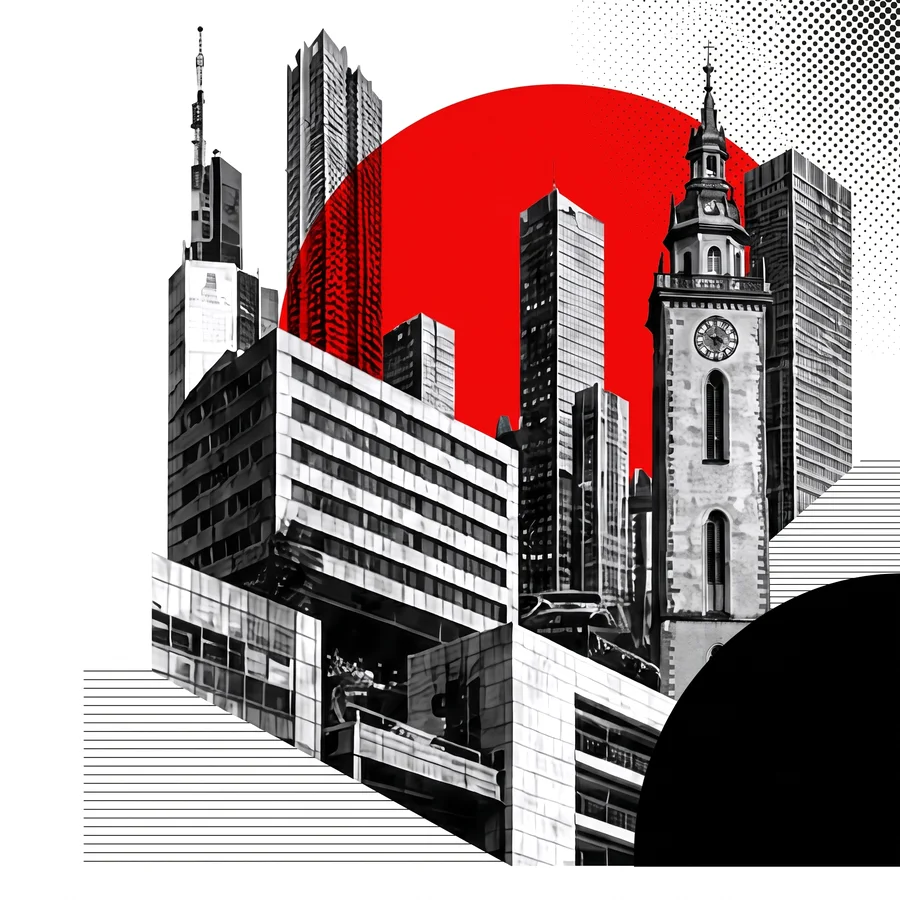
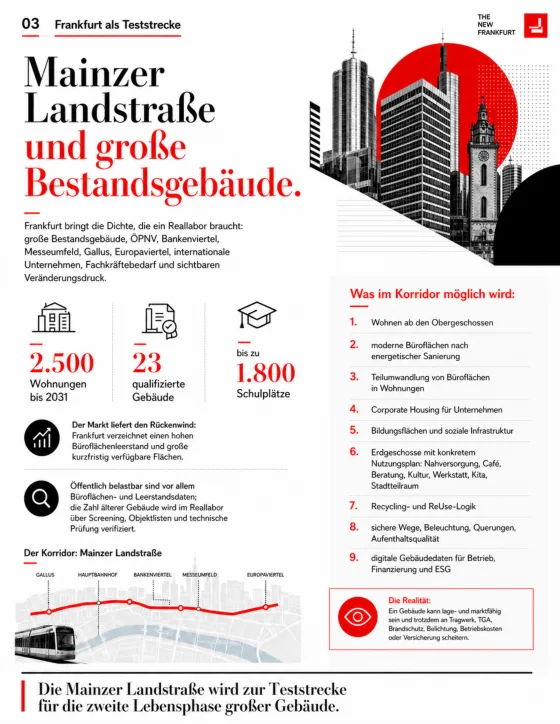
Frankfurt brings the density a real-world lab needs: large existing buildings, public transport, the banking district, the trade fair area, international companies, demand for skilled workers and visible pressure for change.
2,500
apartments by 2031
23
qualified buildings
up to
1,800
school places
The market provides the tailwind: Frankfurt records a high office vacancy rate and large, quickly available spaces.
The reality:
A building can be viable in terms of location and market and still fail on structure, building services, fire safety, daylight, operating costs or insurance.
Mainzer Landstraße becomes the test track for the second life of large buildings.
Three buildings. Today and tomorrow.
Large existing volumes become housing, social infrastructure and vibrant quarters.
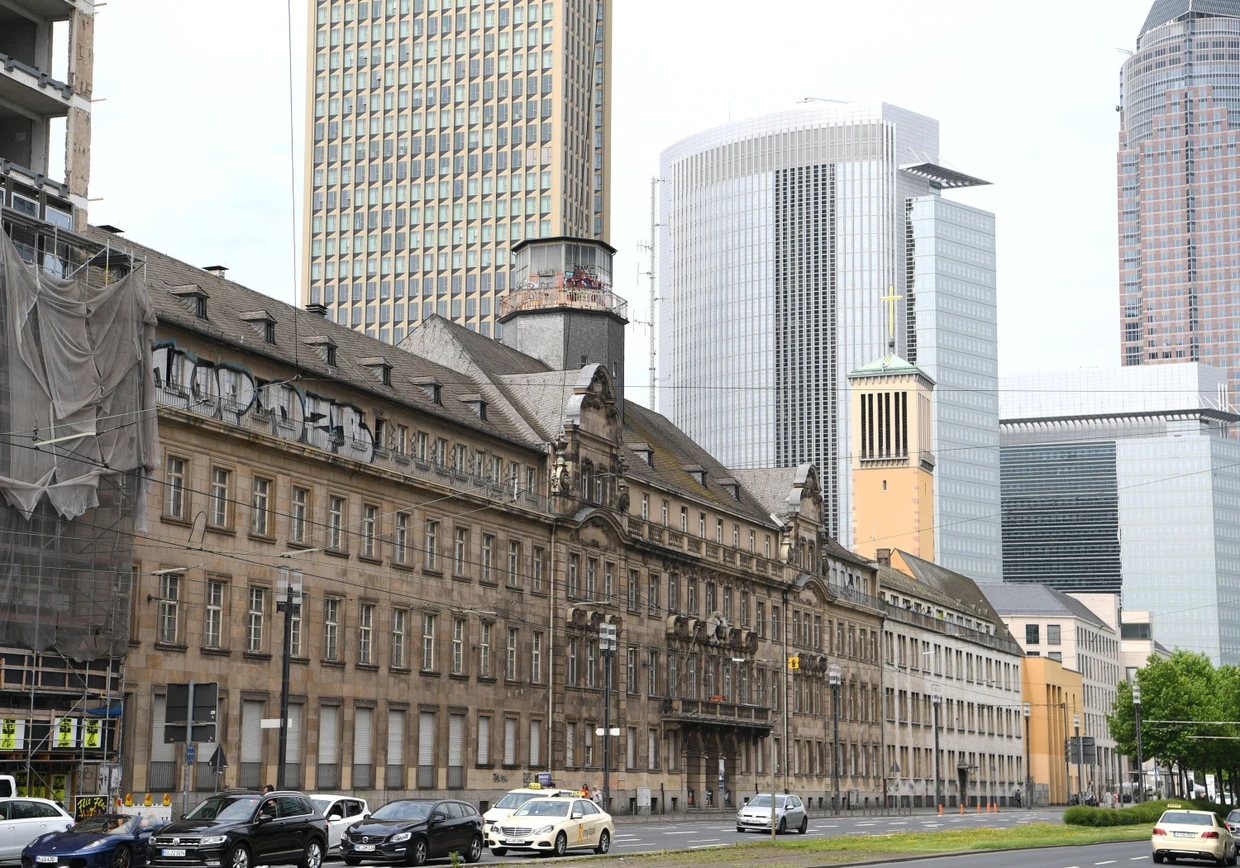
Former Police Headquarters
A striking building with high visibility and signal effect. A bridge project for new usage concepts.
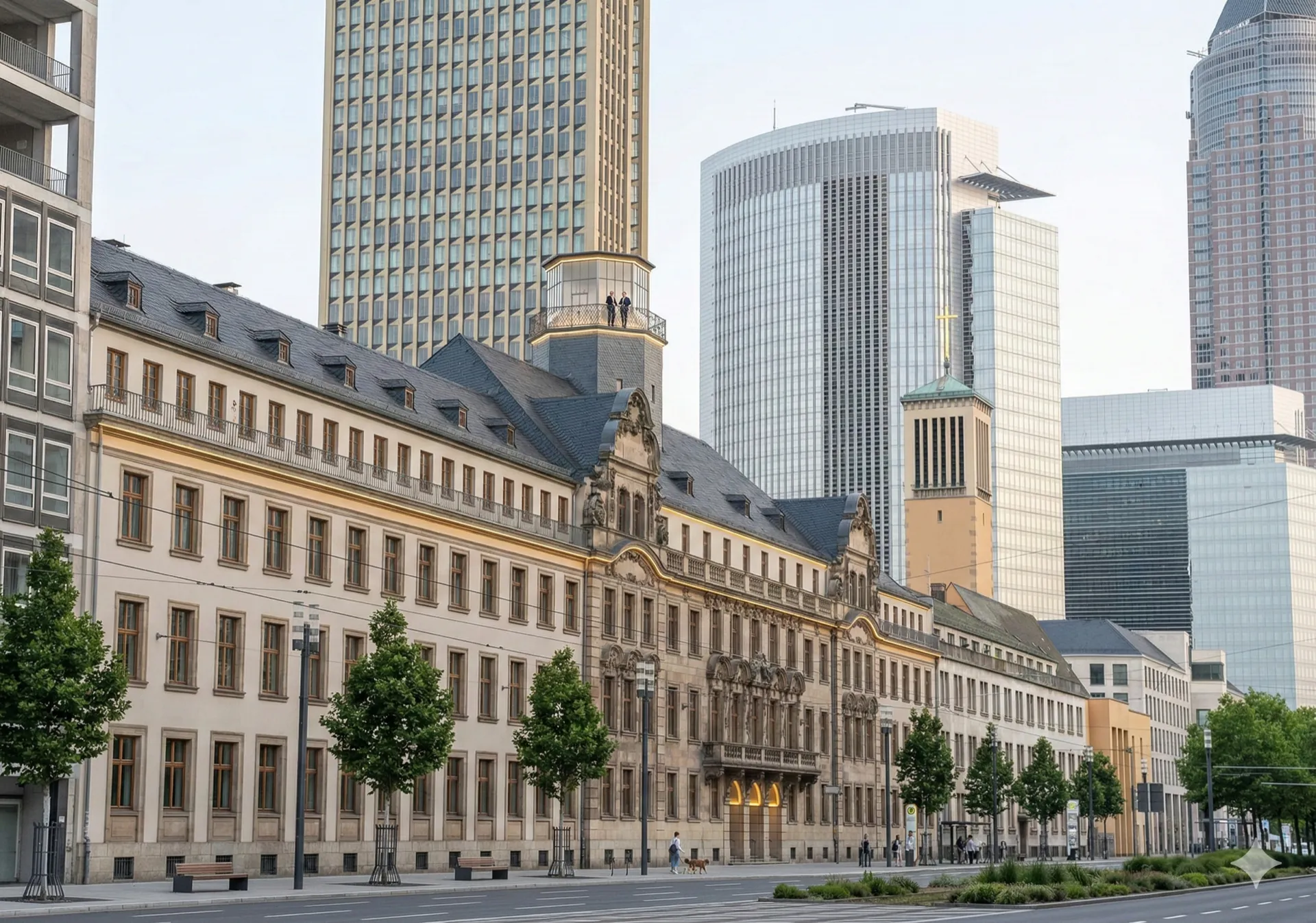
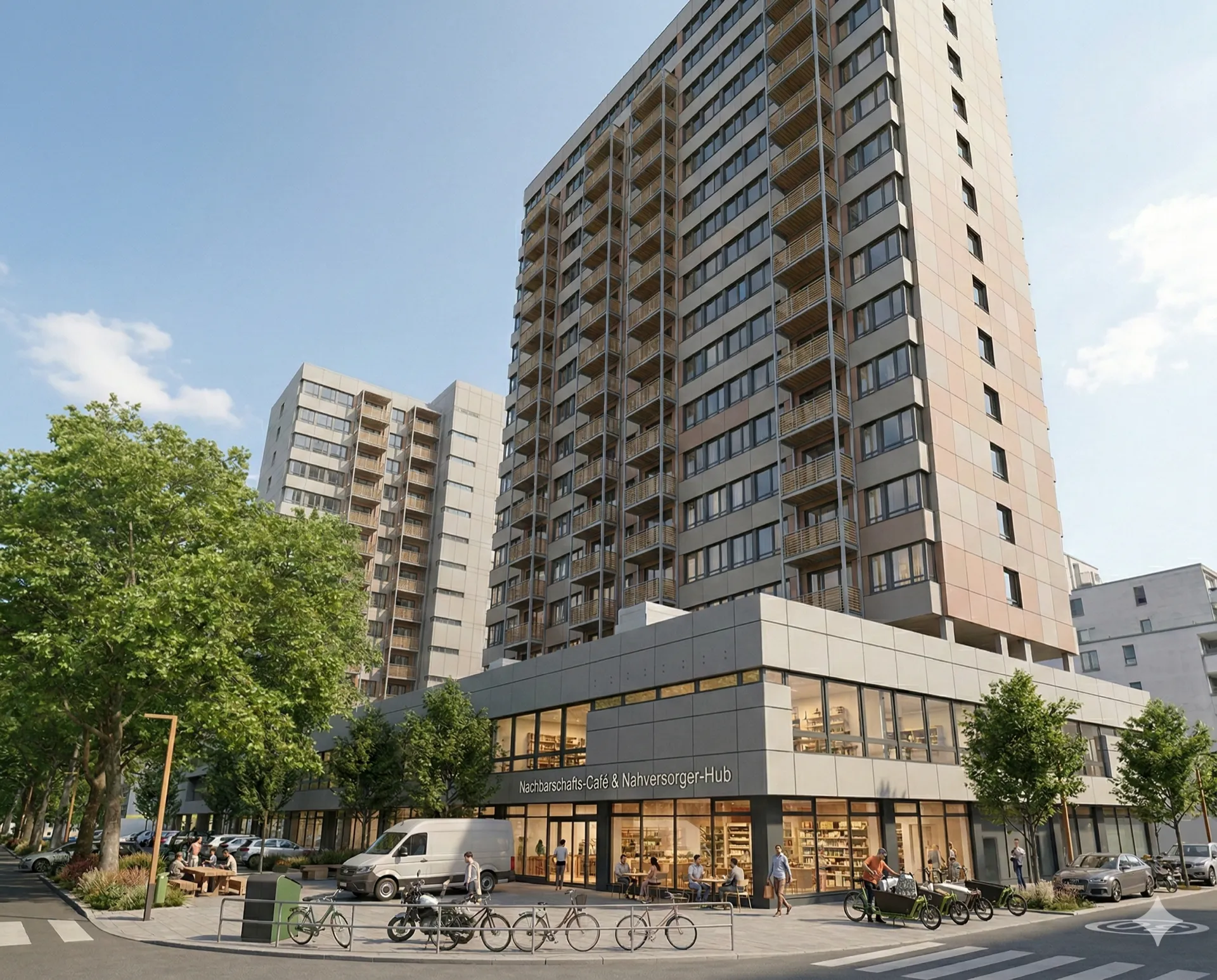
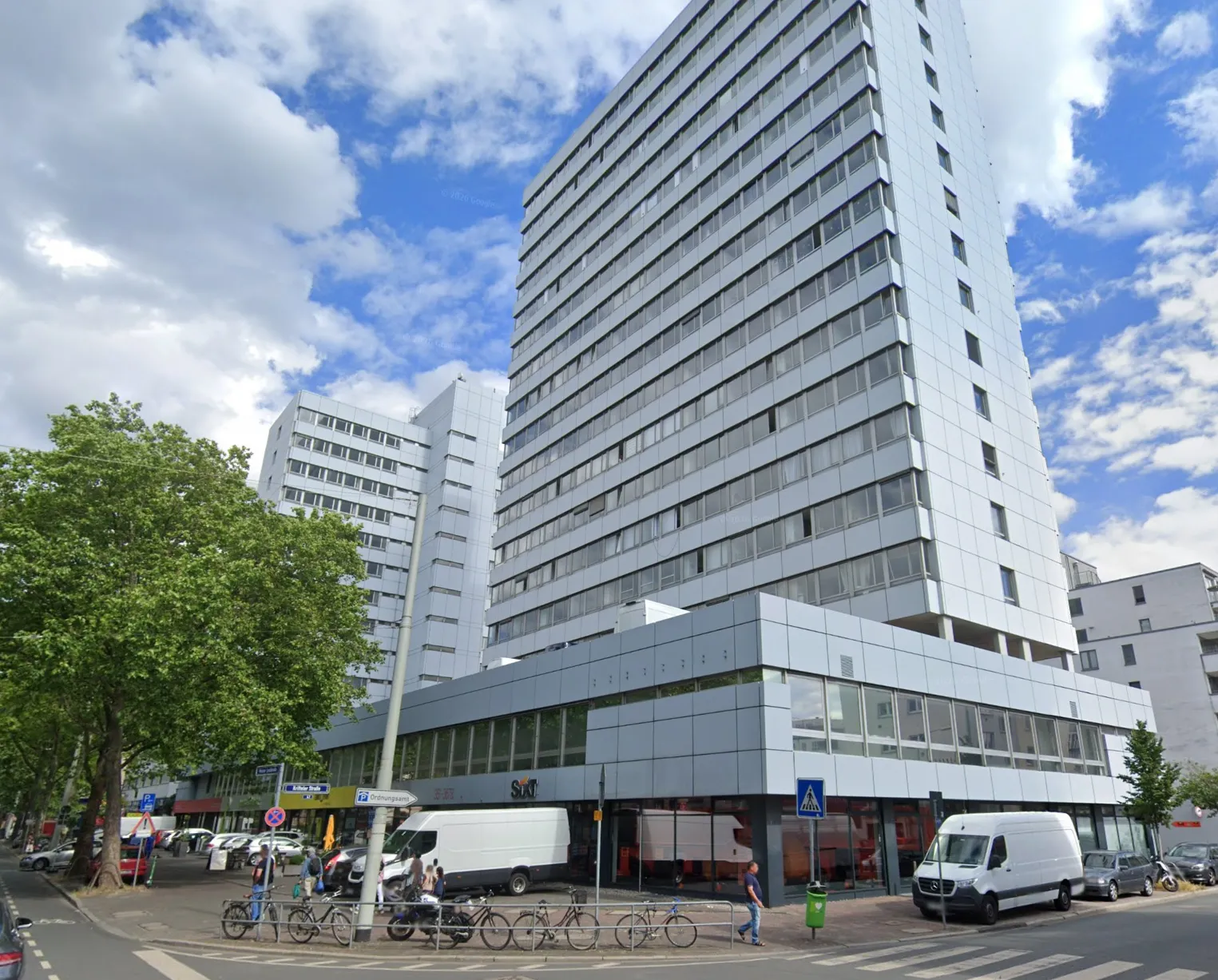
Mainzer Landstraße 351–353
Two office towers from 1972 in the Gallus district. Converted into affordable, beautiful housing with neighborhood spaces such as a daycare center or café on the ground floor.
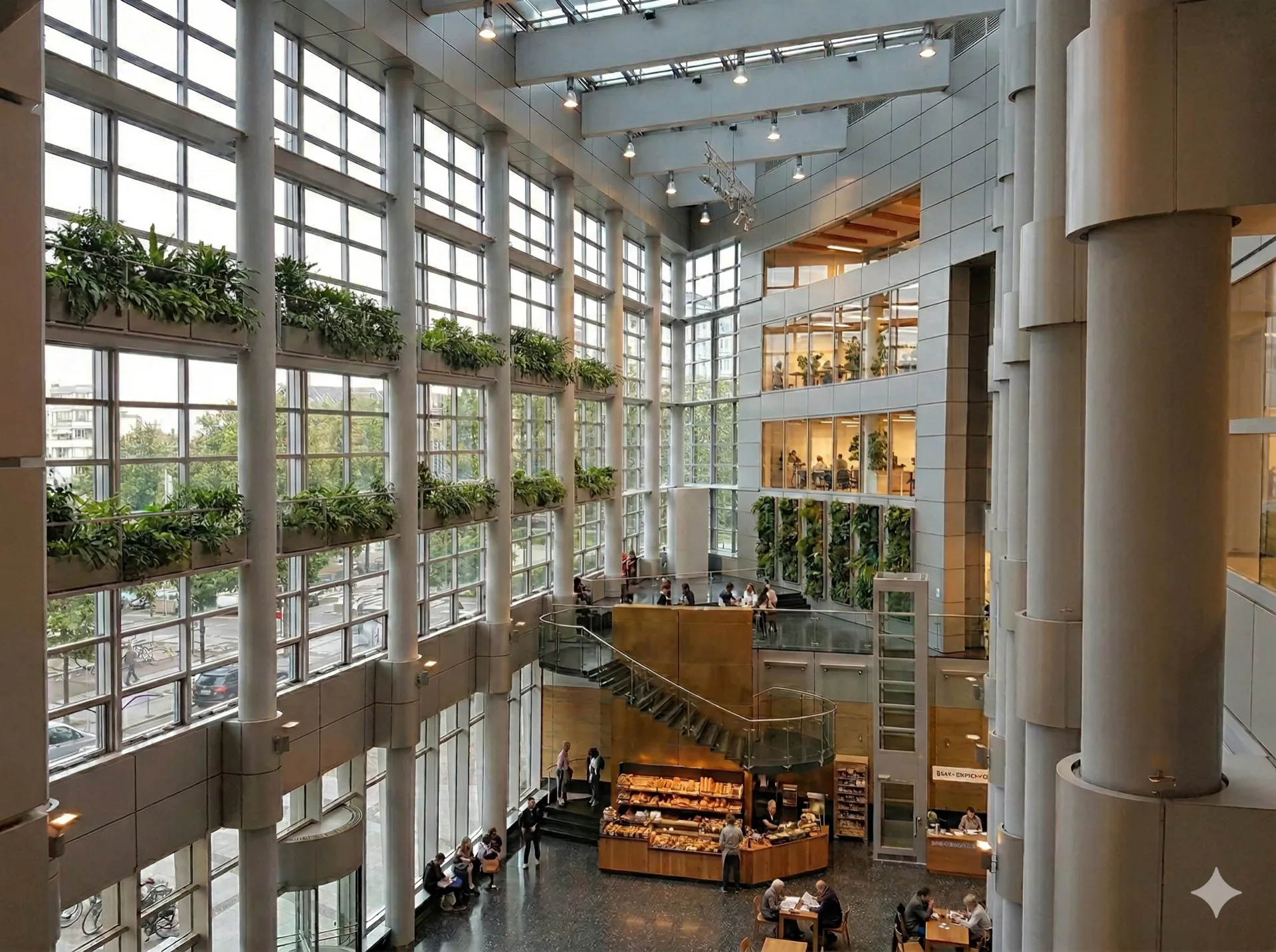
Pollux
A defining high-rise from 1995 at the trade fair. Modular new mixed use with standardized components.
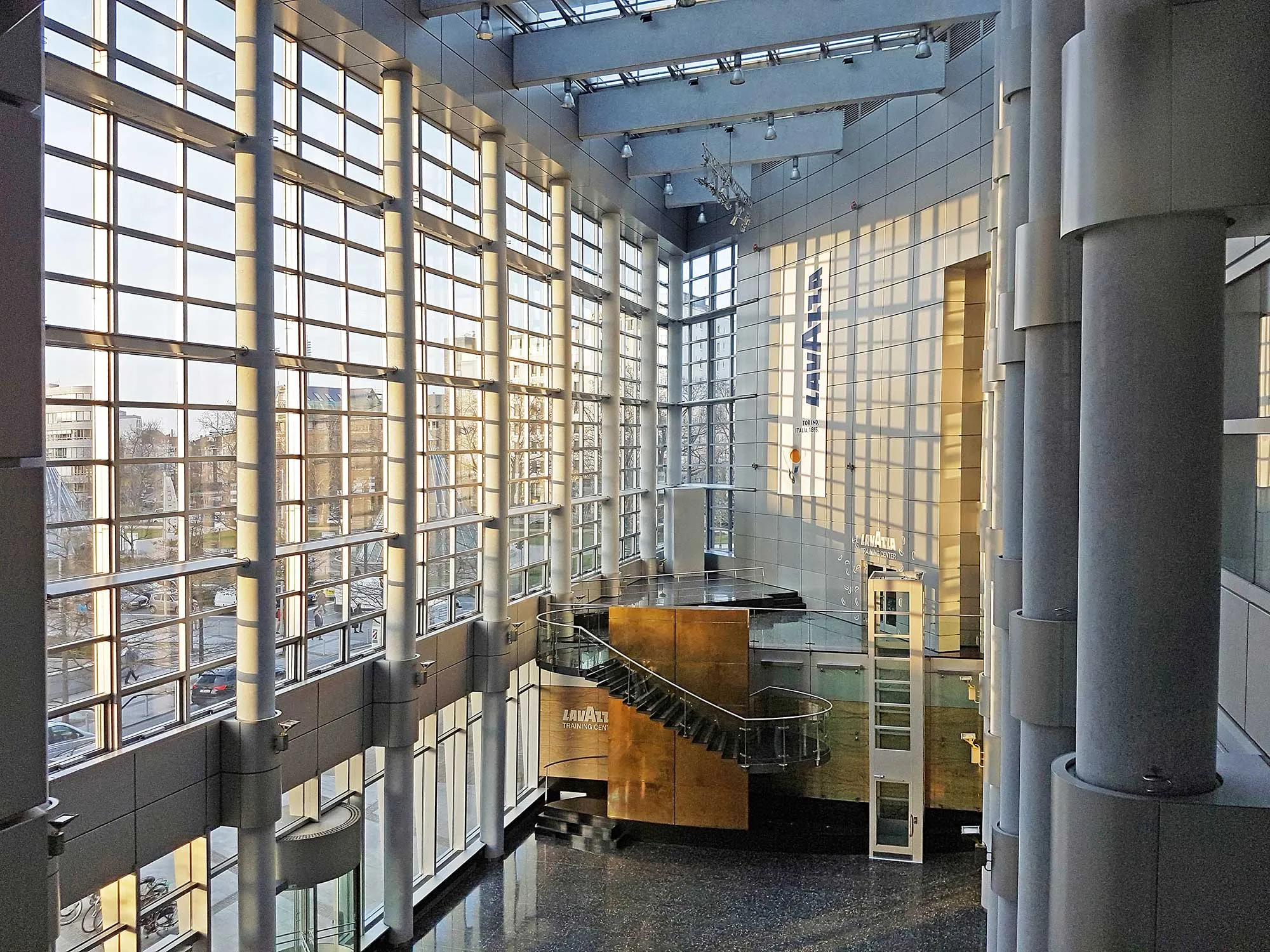
Office, housing, employee retention.
Frankfurt can test a building type that matches its labour market: modernized office space, additional housing, services and social infrastructure in one property or neighbourhood.
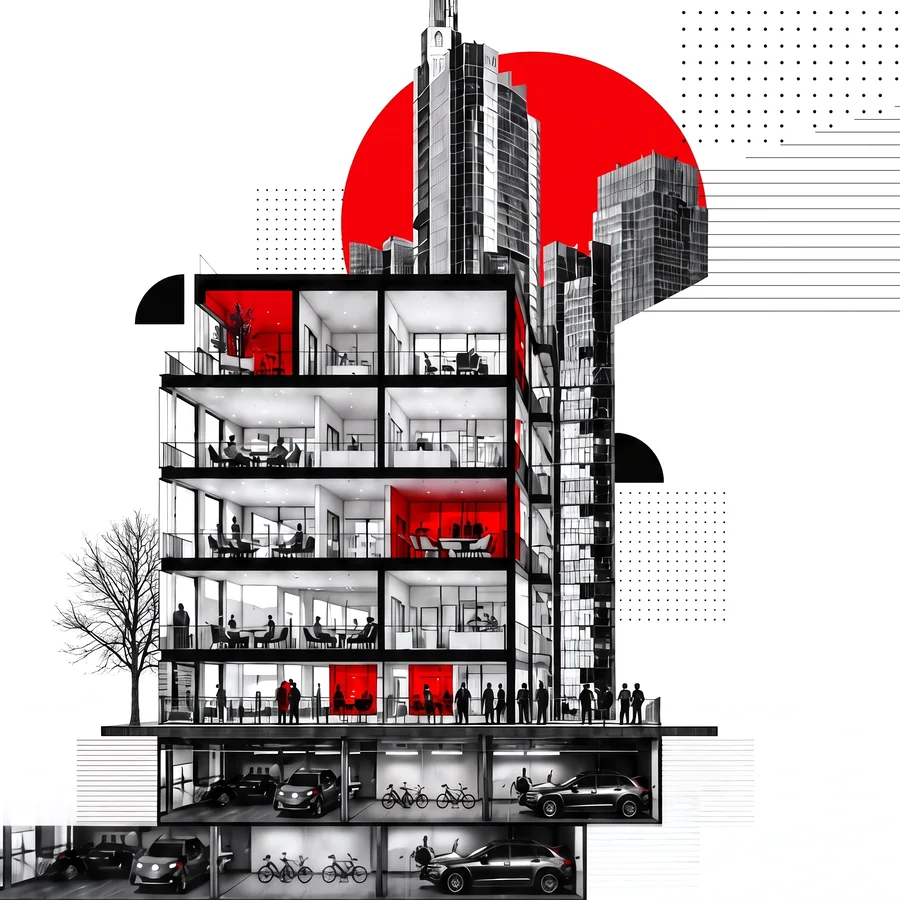
First preference
Office to housing, where floor plan, daylight, structure, fire safety and the business case allow it.
Second strong path
Energy retrofit plus partial conversion of individual sections into apartments.
The reality:
Living and working in the same building require clean separation: access, noise, fire safety, security, service charges, tenancy law and insurance.
The office building of the future can be workplace, home and arrival space at once.
What the lab delivers.
THE NEW FRANKFURT bundles seven functions that individual owners rarely have available at the same time at an early project stage.
What counts is capability in the system.
Applied research and user perspective
Technical engineering and delivery capability
PropTech and data ecosystem
Technical survey on site
Risk, quality and insurability
The lab hub as a place to work
Recycling, reuse and circular material logic
The real-world lab turns specialist knowledge into a shared delivery process.
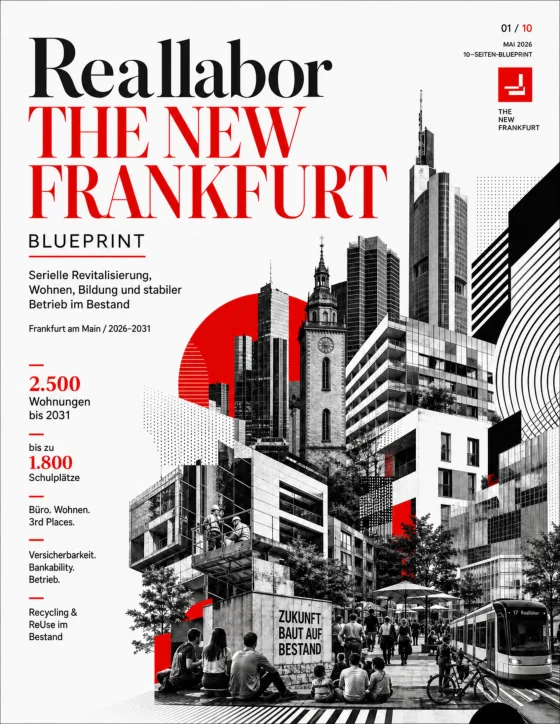
Whitepaper
The complete blueprint as a PDF.
This page gives the overview. The blueprint holds the detail: every review path in the process, the six levels of the business case in full, the complete risk inventory, international references for 3rd places and the full glossary. Free by email.
The lab process.
Projects run through an end-to-end process: from the idea for a use, through assessment, to stable operation.
- 1
Idea
Use hypothesis, neighbourhood, ownership situation, building type.
- 2
Assessment
Up to eight weeks: regulation, funding, bankability and ESG, alongside the technical inspection on site.
- 3
Bankability pass
Project file for owners, banks, investors, insurers and authorities.
- 4
Delivery
Construction, cost, schedule, serial fit-out packages, recycling and reuse.
- 5
Stable operation
Building passport, maintenance, ESG reporting, use mix, monitoring.
The reality:
The process has to test hard early enough and document completely later. Only then does a single project become a repeatable model.
THE NEW FRANKFURT turns an idea into a verifiable path all the way to operation.
Method instead of wishful maths.
Every building is an investment, risk and operating model at once. The business case comes from the interplay of six levels, not from a single target rent and not from a subsidy pot.
Programme frame: 2,500 apartments
- 175,000 m² of residential space
- 3,500 euros per m² of residential space
- Funding logic via KfW and Hessian rental housing support
The reality:
A project has to remain viable even when construction time, financing costs or technical findings turn out worse than planned.
The six levels:
1. Use
2. CapEx
3. Funding
4. Revenue
5. Risk cover
6. Reporting
The business case starts with the building and ends with its operation.
Places where a city holds together.
Places beside home and workplace where people come together, learn, work, experience culture and build neighbourhood. They decide whether converted buildings turn into a living quarter.
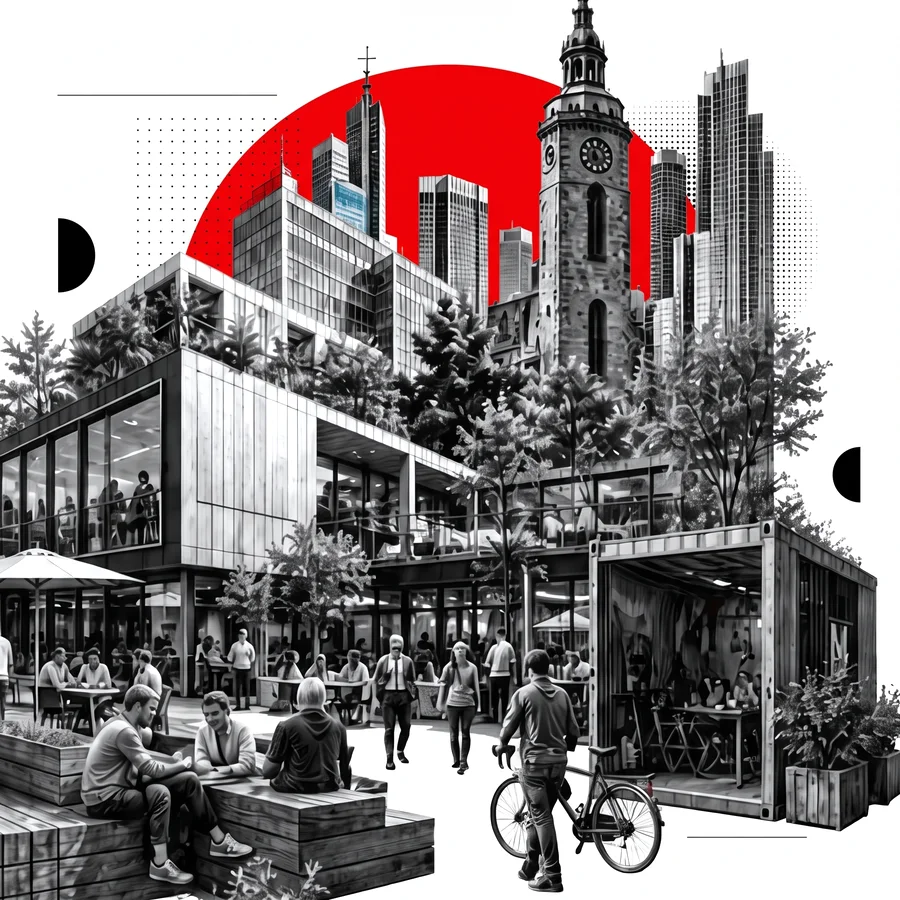
For Frankfurt this means:
- 1.Library and place to learn
- 2.Café with a neighbourhood function
- 3.Repair and recycling workshop
- 4.Counselling and social work
- 5.School and daycare outside core hours
The reality:
3rd places need operators, opening hours, cleaning, security, funding, a programme and responsibility. Floor space alone does not build a community.
Good buildings create space. Good neighbourhoods create encounter.
Transparency makes capital more realistic.
Investors can assess risk better when substance, construction time, liability, fire safety, operation and ESG become visible early. That is why the lab treats insurability as a discipline of its own.
What is examined includes:
- 1.Risk inventory per property
- 2.Technical due diligence and substance testing
- 3.Fire safety and building services risks
- 4.Delay and rent loss risks
- 5.ESG and performance risks
The reality:
Insurability does not come from a product at the end, but from documentation across the whole project.
Transparency makes risks assessable. Assessable risks make financing more realistic.
Key terms explained briefly.
The most important terms around real-world labs and serial revitalization. The full glossary is in the blueprint.
- Real-world lab
- A time-limited, real testing space in which innovations are tested under real market conditions.
- Serial revitalization
- Standardized, industrial processes and component solutions for scalable modernization of existing buildings.
- Bankability
- The suitability of a project to be viable, transparent and assessable in terms of risk for financiers.
- Bankability pass
- Evidence of technical, economic, legal and ESG compliance to improve financing capability.
- Reuse
- The direct reuse of components without energy-intensive reprocessing.
- 3rd place
- Publicly accessible places between home and workplace that foster encounter and community.
Real-world lab THE NEW FRANKFURT: a blueprint for serial revitalization of existing buildings.
Contact
Become part of THE NEW FRANKFURT.
Owner, planner, bank, municipality or scientist: choose what you can contribute and we will take it from there.
Get involved